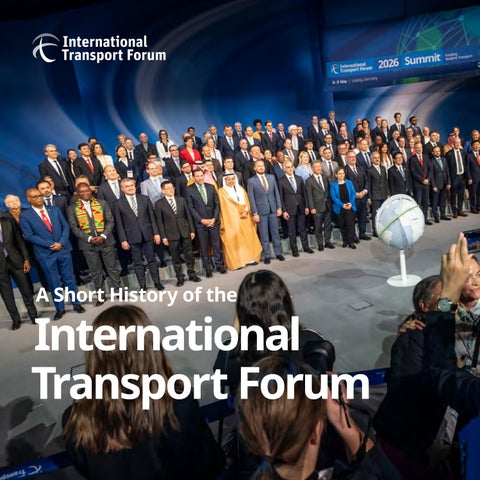
A Short History of the
International Transport Forum
Please cite this publication as: ITF (2026), A Short History of the International Transport Forum, OECD Publishing, Paris
A Short History of the
International Transport Forum
Contents
6
A Short History of the International Transport Forum
The Beginnings: Convening Reconstructing the World of Europe 10 Transport 16
Evidence for Better Policies 24
A Truly Global Platform 36 7
Foreword
The International Transport Forum celebrates its twentieth anniversary in 2026. This milestone offers a reason to celebrate and a welcome opportunity to look back. What have we achieved? How have we become what we are? Which ideas, events, people have shaped the organisation? Knowing the past is important to find the right path forward. Only if we know how we have become what we are can we make wise choices for our next steps. This is as true for institutions as for humans. Organisations that proudly build on their past are stronger, more resilient, and better equipped to face the future. In this sense, this document is the ITF’s way of marking its anniversary: an attempt to capture what made us what we are over the past two decades. It draws on published and unpublished sources and on conversations with protagonists of the early years who kindly offered their time. Naturally, such a brief history of the ITF cannot cover everything. Those who know us very well will have little difficulty in pointing out aspects that might also have been mentioned. I am convinced, though, that every reader of this short history of the International Transport Forum will come away from it with a better understanding of what the ITF is, and what it is about.
Young Tae Kim ITF Secretary-General
“Only if we know how we have become what we are can we make wise choices for our next steps. This is as true for institutions as for humans.”
1953–2006
The Beginnings: Reconstructing Europe
Rebuilding transport networks was fundamental to restoring prosperity after the devastations of World War II. In Europe, a regular conference of national transport ministers took on the task.
The history of the International Transport Forum begins with the creation of the European Conference of Ministers of Transport in 1953. Still today, the Protocol that established the ECMT, or CEMT in French, remains the legal foundation of what evolved into the International Transport Forum just over a half a century later, in 2006. The political backdrop to the foundation of the ECMT was sombre. The Second World War had caused immeasurable destruction in many regions of the globe, not least in Europe. Much of the continent’s transport infrastructure lay in ruins; railways, roads, ports and bridges had been devastated. What remained was mostly inefficient, fragmented and ill-suited to the demands of reconstruction and recovery. Overcrowded trains became a highly visible symbol of the challenges governments faced in the immediate postwar era, and rebuilding transport networks was a key to regaining prosperity. A “European Transport Pool” It was in this context that the idea of co-ordinated European transport policy emerged. In January 1953, French Prime Minister René Mayer and Foreign Minister Georges Bidault convened representatives from Austria, Belgium, Germany, Luxembourg, the Netherlands and Switzerland in Paris to discuss an expert proposal for a “European Transport Pool”. A three-month conference that same year under the auspices of the Organisation for European Economic Cooperation (OEEC – which became the OECD in 1961) then laid the groundwork for a permanent intergovernmental body for transport policy co-ordination. A mission to the United States, organised by the OEEC in in March 1952 to study the organisation of transport at Federal and State level, had suggested such a conference.
The conference’s final report after three rounds of negotiations between March and June 1953 concluded that all factors affecting transport policy should be more closely co-ordinated among European governments. On 17 October 1953 representatives of the founding governments signed the “Protocol concerning the European Conference of Ministers of Transport” in Brussels, formally establishing the ECMT. The Second World War had caused immeasurable destruction in many regions of the globe, not least in Europe. Much of the continent’s transport infrastructure lay in ruins The new organisation’s mandate was clear and pragmatic: to create “a procedure whereby effective steps can be taken to co-ordinate and rationalise European inland transport of international importance”. The founding members included 15 Western European countries and Türkiye, plus the Anglo-American Zone of the Free Territory of Trieste. The United States and Canada joined as associate members—an early indication of the organisation’s broader international dimension. Lean and flexible The 1953 Protocol set out a deliberately lean and flexible institutional structure. The Council of Ministers, composed of national ministers with responsibility for transport, acted as the central decision-making body, meeting regularly to adopt resolutions and recommendations. The Committee of Deputies, made up of senior officials from member governments, prepared Council decisions, supported by a small “administrative secretariat”, housed within the OEEC (and later the OECD). The 1955 annual report notes that “a very simple operation” had been set up, “by appointing only one official”, the Secretary-General. Over time, a growing network of committees, expert groups and, in 1968, an Economic Research Centre were added. This research capacity (later fused with the OECD
The Beginnings: Reconstructing Europe 11
transport research units to form the Joint Transport Research Centre, JTRC) soon became a hallmark of the ECMT’s approach, underpinning policy discussions with empirical evidence and comparative analysis. Incubator for policy ideas From the outset, the ECMT contributed to practical solutions that facilitated cross-border transport. One notable achievement was the 1955 Convention establishing Eurofima, a supranational body for financing railway rolling stock, which addressed the capital constraints of post-war railways and underpinned the renewal of European rail networks. The ECMT also became an incubator for policy ideas that later influenced broader international standards. Its work on road signs and signals fed into international protocols and conventions adopted in 1968 and 1971, thus helping to harmonise traffic rules across countries. ECMT recommendations on seatbelt wearing, based on evidence gathered that showed it saved lives, laid the foundations for the widespread introduction of seatbelt regulations. Similarly, the ECMT pioneered the case for alcohol limits for driving. Discussions in 1964 on road pricing anticipated later debates on user charging and infrastructure financing. The new organisation’s mandate was to create “a procedure whereby effective steps can be taken to co-ordinate and rationalise European inland transport of international importance”. And as early as 1973, the ECMT addressed environmental impacts of transport by creating a steering group to “consider the relationship between transport policy and environment policy”, leading to a series of related resolutions including one in 1983 which, among other things, laid down the “polluter pays” principle.
12
Overcrowded train in immediate postwar Germany
Facilitating cross-border transport Besides infrastructure development, a central motif of the ECMT’s founders had been to dismantle barriers to international transport. Yet even as European economies became more integrated in the 1960s, cross-border road haulage remained heavily constrained. As a rule, bilateral agreements limited the number of journeys trucks could make between specific countries, forcing empty return trips and putting heavy administrative and economic burdens on operators that hampered pan-European trade.
A Short History of the International Transport Forum
Ministers of 16 nations sign the “Protocol concerning the European Conference of Ministers of Transport” in Brussels on 17 October 1953 (pictured above)
The ECMT responded with the Multilateral Quota system for international road haulage. Established in 1973/4, the system was to become one of its most impactful instruments. It introduced a pool of permits that allowed hauliers to operate across multiple countries under a common framework, significantly simplifying crossborder transport but with some regulatory oversight. Broadening the agenda Slowly but unmistakably, transport policy thinking shifted from its focus on efficiency and capacity toward a more holistic view of transport’s role in economic, social, and environmental outcomes.
One example was the Council of Ministers’ 1978 decision that all member countries would grant motorists with disabilities the same special parking rights as they offered their own nationals, on condition their car display a badge showing the international wheelchair symbol. This resolution was extended in scope in 1997, and in 1998 the European Union (EU) adopted the approach for EU member countries. On another front, the creation of the International Road Traffic and Accident Database (IRTAD) by the OECD in 1988 – managed since 2004 by the ECMT, and then the ITF – harnessed statistics and data to inform
The Beginnings: Reconstructing Europe 13
Customs officials examine a lorry at the German-Dutch border, 1968
more effective road safety policies, a reaction to the unsustainably large numbers of crash fatalities that had come as a cost of the rapid growth of road traffic. The Multilateral Quota allowed hauliers to operate across multiple countries under a common framework, thereby significantly simplifying cross-border transport. Similarly, the 1999 Charter on Access to Transport Services and Infrastructure reflected a growing emphasis on accessibility and equity, driven by the realisation of transport’s role as enabler of social participation. 14
The Multilateral Quota over time also incorporated environmental and social standards, reflecting broader policy priorities of member countries. Expansion and pan-European integration Along with the scope of its work, membership of the organisation gradually expanded. Yugoslavia joined in 1955, followed by other countries over the following decades: Ireland (1963), Finland (1975), Iceland (1998), Liechtenstein (2000) and Malta (2002). The organisation also extended its reach beyond Europe with new nonEuropean associate member countries. Japan joined in 1970, Australia in 1973, New Zealand in 1991, Korea in A Short History of the International Transport Forum
CONFÉRENCE EUROPÉENNE DES MINISTRES DES TRANSPORTS
istres 2003. e qui tence ions, n des clure de la stres.
EUROPEAN CONFERENCE OF MINISTERS OF TRANSPORT
dans
C=VUXWVU:
1953
2003
92-821-0321-8
since pares what ption. ions, rking ercise f the
OM.
2000 and Mexico in 2003, foreshadowing the later global orientation of the International Transport Forum. The end of the Cold War provided a major impulse for the ECMT. Following the fall of the Iron Curtain, no less than 22 countries from the former Communist bloc joined between 1991 and 2003, eager to re-establish historical transport links. This expansion, which also included Iceland (1998), turned the ECMT into a true pan-European body, bridging Cold War divides and supporting transport systems’ transition in newly market-oriented economies. During this time, the ECMT advanced strategic concepts like the pan-European transport corridors, first articulated in 1993 at an ECMT meeting in the Netherlands – a landmark idea that evolved into today’s Trans-European Transport Network (TEN-T).
L’Acquis CEMT Principal Acts of the ECMT
As the 20th century drew to a close, the organisation had established itself as a key actor in transport policy; its influence recognised in 1990 with the award of the Prognos Prize for its “foresightful and dedicated work”.
The Beginnings: Reconstructing Europe 15
2006 –2012
Convening the World of Transport
The creation of the International Transport Forum established the only multilateral organisation with a global mandate for all transport modes. Its annual Summit quickly became the world’s premier transport policy event.
Ministers and V IPs at the first I TF Summit in 2008. From left to right: Germany’s Minster of Transport, Wolfgang Tiefensee; Rajendra K. Pachauri, chair of 2007 Nobel Peace Prize Winner IPCC; German Federal Chancellor Angela Merkel and Finland’s Transport Minister Leena Luhtanen.
By the first decade of the new millennium, globalisation had created a world characterised by dense networks of trade, finance and mobility, underpinned by increasingly sophisticated transport systems and governance frameworks. At the global level, the W TO provided rules for trade, while at the regional level, the European Union was pushing ahead with deep integration far beyond the original liberalising agenda of ECMT. The ECMT’s original task of reconstructing Europe’s transport systems had been accomplished, the aim of revitalising cross-border connectivity achieved. And while the founding fathers of the ECMT had naturally been preoccupied with road, rail and inland waterways and limited the ECMT’s mandate to these land-based modes, the massive expansion of intercontinental trade and travel had now put aviation and maritime transport very much into the focus of policy. Growing need for dialogue Total goods transport by sea more than doubled from 4 billion tonnes in 1990 to 8.4 billion tonnes by 2010. Container throughput skyrocketed from under 90 million TEU (Twenty-foot Equivalent Units) in 1990 to well above 500 million. In aviation, passenger numbers nearly tripled as deregulation and Open Sky agreements spawned low-cost carriers and unlocked new destinations. The sheer scale and complexity of global mobility systems and the interdependence of economies posed new challenges that created a growing need for international dialogue and policy coordination beyond regional frameworks. Against this backdrop, the members of the ECMT were considering how to position their organisation in a fastchanging world. Ultimately, these challenges found an institutional response in the evolution of the ECMT into the International Transport Forum.
A decisive impulse A decisive external impulse came in 2004. The accession of the post-communist European countries to the ECMT in the 1990s had strengthened the ECMT’s raison d’être, by providing the new members with access to the European Union’s road freight market via the licences of the ECMT Multilateral Quota system, adding to the organisation’s economic and pan-European relevance. That changed when, on 1 May 2004, the EU accepted ten new member countries. With one stroke, the eastern European states that had flocked to the ECMT in the 1990s and whose hauliers had since relied on ECMT licences to operate across Europe, now joined the EU’s single market which – despite transitional arrangements for cabotage and market access to protect Western European operators – provided opportunities that made the license system of the ECMT Multilateral Quota system appear restrictive by comparison. There was a growing sense that transport policy, although ever more important to the functioning of societies and the economy, was not getting the attention it deserved. Eastern enlargement of the EU brought into sharp relief the extent to which the EU had assumed regulatory dominance over the continent’s transport system. For decades, the ECMT’s thematic committees had served as incubators for policies, which would then be taken by ministers to the international standard setting bodies, notably the United Nations’ Economic Commission for Europe (UNECE). Now the European Commission and the European Council, the meeting of EU portfolio ministers, were the places where most policy decisions were happening.
Convening the World of Transport 17
Repositioning the ECMT First, in a globalised economy, transport policy needed to be discussed and shaped on the global level as well. The ECMT was well placed to become such a global forum: it was already a well-established policy body with important non-European stakeholders. Second, the ECMT’s self-limitation to the land-based transport modes rail, road and inland waterways seemed anachronistic in a context where globalisation meant maritime shipping and aviation had acquired vital importance.
A French stamp celebrates the eastern enlargement of the European Union in 2004
Merging transport research Yet the ECMT still had much to offer. The work of its Economic Research Centre had become highly appreciated by policy makers. Its ability to provide empirical evidence was now enhanced by the amalgamation of the OECD’s road transport programme with ECMT research on 1 January 2004 into the ECMT/ OECD Joint Transport Research Centre ( JTRC) under the direction of ECMT. The ECMT also had long hosted renowned symposia on transport research topics every three years, drawing several hundred experts and policy makers for a week of discussion and debates. Not least, the ECMT community included important nonEuropean countries as associate members that gave its work a global dimension: Australia, Canada, Japan, Korea, Mexico, New Zealand and the United States. These had moved even closer to ECMT with the creation of the JTRC, of which they had become full members and to which they contributed financially via the OECD. In parallel to the sometimes-difficult process of setting up the JTRC, ideas for a transformation of the ECMT were emerging, evolving around three main aspects. 18
Third and high on the minds of the actors, there was a growing sense that transport policy, although evermore important to the functioning of societies and the economy, was not getting the attention it deserved. With the rise of the internet and new media, it seemed paramount to reposition the organisation much more clearly in the perception of policy makers and public alike. This, many had become convinced, required a break from the ECMT, which had always maintained a lowkey approach and did not even possess a professional communication function. A “Davos of Transport” Thinking about reform commenced as early as 2000, in the run-up to ECMT’s 50th anniversary. Then, members had launched a reflection process in an ad-hoc group, leading to a “Declaration on the Future Direction of the ECMT” endorsed by Ministers in 2003 which expressed the intention to position the organisation as an “active intermediary between the Member States of the European Union and outside countries”. With tailwind from the successful integration of associate members into the JTRC in 2004, the process gathered momentum in the following year. At their 2005 meeting in Moscow, ministers agreed to transform the ECMT into “an attractive and publicly recognised international Ministerial Forum which increases the understanding A Short History of the International Transport Forum
Germany’s Federal Minister of Transport, Wolfgang Tiefensee, with Secretary-General Jack Short in Sofia, Bulgaria, in 2007
of the importance of Transport”. A High-level group made up of senior officials drawn from members and associated countries was tasked with working out a proposal for a new format and presenting it for decision at the next Ministerial meeting. The model that some protagonists had in mind was to create a “Davos of Transport”: a highly recognisable annual fixture with a single theme and a permanent venue replacing what Wolfgang Tiefensee, Germany’s Federal Minister of Transport, saw as the “travelling band” of ministers that ECMT meetings had become.
Solving the money question The crux was money. Organising a Ministerial was a costly affair for the host country, but it was a one-off expenditure and brought high visibility in return. With a permanent venue, another funding mechanism would have to be found. If associate members were to accede, additional contributions offered a path. But, having just joined the JTRC and committed to funding it, the associates were not prepared to see their membership fees rise further, and ultimately the desire to have them fully on board for the new format outweighed pecuniary considerations.
Convening the World of Transport 19
A deadlock threatened to stifle the project when a surprise proposition came: “Germany has offered to provide a permanent conference venue and double the German subscription to facilitate this”, the High-level Group informed Ministers: “The Group welcomes this offer and recommends that Ministers accept it.” The Dublin Declaration With that offer, the die was cast. On 18 May 2006, the ECMT Council of Ministers, assembled under the Presidency of Ireland in Dublin for its 90th meeting, unanimously adopted the “Dublin Declaration” – the founding document of the International Transport Forum. “Today, in Dublin, we establish the International Transport Forum”, the Declaration stated. “Our aim is to foster a deeper understanding, among policy makers and wider audiences, of the role of transport as a key to economic growth and of its impact on the environmental and social dimensions of sustainability.” A second objective immediately followed: “The aim is also to improve communications by adapting our work to the requirement of the modern media” and creating “a recognisable entity with a public face”. Membership of the ITF would be “international” (the declaration noted “with pleasure” that the associated countries had agreed to join) and activities “cover all modes of transport”. Ministers would meet once a year in Germany, with invited “key figures” from civil society on “a single topic of world-wide strategic importance“. The new structure The legal basis for the new Forum stayed the ECMT protocol, Ministers clarified, as “we are not creating a new international organisation”. The Secretariat would remain in Paris, housed by the OECD. The Committee of Deputies – the officials representing member countries in between Ministerials – was renamed 20
the ITF Transport Management Board (TMB) and tasked to “proceed with the immediate implementation of the reforms outlined in the Declaration”. The TMB was to form a “Conference Task Force” charged with steering the preparation of the annual event. European activities, notably the Road Transport Group which managed the Multilateral Quota system, would continue. Also, the mandate of Secretary-General Jack Short, an Irishman who had joined the ECMT in 1984 and led the Secretariat since 2001, was renewed for a second five-year term. Continuity and change While these steps signalled a measure of reassuring continuity, the Dublin Declaration also announced further “significant transformation” beyond the new format and relocation of the Ministerial meeting. The new organisation would drop the old committee system, under review since 2004 – a transformative step to which the Dublin Declaration alluded only in passing, noting that the ITF would provide “a modern, efficient and streamlined structure to serve transport Ministers in the future”. “These decisions have immediate effect in creating the entity of the Forum”, the Ministers declared; “the conference in Germany in 2008 will be the first to be held fully under the new arrangements.” Getting ready From one day to the next, the focus of the Secretariat’s work shifted from supporting the work of the committees to becoming an event organiser, and one that had to fulfill considerable expectations. Research activity in working groups and at roundtables continued but was now very much geared towards providing input for the new high-level event.
A Short History of the International Transport Forum
The learning curve started by finding the best possible venue. The Dublin Declaration had established Germany as the permanent home of the Forum; to which German city ITF Ministers would travel from 2008 on was, for now, an open question. Following a competitive tender, one of Europe’s oldest merchant cities with a world-famous trade fair was selected in late 2007: Leipzig. The Secretariat set to work at once. “I don’t know how many trips I made to Leipzig to prepare everything”, then Deputy Secretary-General Alain Rathery later recalled.
Convening the world of transport On Wednesday, 28 May 2008, 800 participants, including 48 Ministers, assembled in the modern glass-and-steel congress centre on the outskirts of Leipzig for the first International Transport Forum conference in the event’s new home base under the theme “Transport and Energy: The Challenge of Climate Change”, presided over by Finland. At the height of political wrangling about the future of the Kyoto Protocol the topic could not have been timelier and the speaker list more appropriate: Angela Merkel, Federal Chancellor of Germany, Nobel Peace
Billboard announcing the 2012 Summit outside Congress Center Leipzig
Convening the World of Transport 21
The Council of Ministers of Transport during the 2009 Summit
Prize winner Professor Rajendra Pachauri of the International Panel on Climate Change (IPCC) and Yvo de Boer, Executive Secretary of the UN Convention on Climate Change (UNFCCC). The new ITF had succeeded in its new mission to convene the world of transport for three days of debate and networking: Ministers were there, but equally CEOs, heads of International Organisations and development banks, also the important business associations representing sectors from the automotive industry to freight forwarders, shipping to airlines, as well as other non-governmental organisations and advocacy groups. Praise from the chancellor In her opening speech, Chancellor Merkel reminded attendees that she had also served as Germany’s Federal Minister for the Environment. In that role, she reminisced”, I would have dreamed that this would be the first special topic of a World Transport Forum.” 22
Calling climate change a moral, economic as well as political challenge, Merkel offered ITF Ministers her “heartfelt” congratulations on the idea of transforming the European Conference of Transport Ministers into a global body. In doing so, they had “decided to rise to the challenges, not within the confines of Europe, but with a spirit of openness”. “What was once a routine meeting of government representatives is set to become a global platform for issues relating to mobility, transport and logistics”, Merkel said. “Germany will do everything in its power to ensure that this initiative is… a success.” “For this platform offers representatives from the worlds of politics, business and academia from across the globe the opportunity for a regular and comprehensive exchange of ideas. I believe the need for discussion and the many aspects that must be taken into account in these discussions are immense. That is why, in the coming years… you will have a great deal to do.” A Short History of the International Transport Forum
motion Issue 01 | May 2011
www.internationaltransportforum.org
M
A
G
A
Z
I
N
E
Transport for Society
How can transport better serve its users? Road safety: Programmes that work Urban car sharing: One for all Financing: Tougher times
Positive feedback The reaction to the first big ITF Ministerial held under the eye of the public was positive: “Merkel’s speech was invigorating – hugely positive to have such a strong intervention from a head of government. Gave the Forum a real sense of purpose and power”, a TMB member observed after the event. Another delegate noted: “The participation by major non-transport organisations such as the World Bank and UNFCCC served as excellent additions to the programme so that Ministers heard some interesting outside perspectives.” A third country representative praised the “very good elaboration of subjects and objectives”, adding: “If all the following Forums will be as structured and organised as this one, you can expect a lot of participants who will be very interested in the topics [on] offer.”
Global, all modes and growing By 2012, with five successful Leipzig events behind it, attracting an increasing number of ministers and general participants from a growing number of countries, the ITF’s Annual Summit (renamed from Forum in 2011 to avoid confusion between the event and the organisation) had firmly established itself as the world’s largest international gathering of transport ministers and the leading transport policy event. A comprehensive new communication strategy, adopted by TMB in 2010, and a strengthened in-house communications function significantly increased the participation in the Summit by global media. The ITF had even started its own magazine, called motion, with coverage of transport policy issues. Importantly, the accession of India (2009), China (2011) and Chile (2012) had added three important new members, signalling the attractiveness of the new format and highlighting progress in the ITF’s ambition to evolve into a global forum. Not least, as the only intergovernmental body with a mandate for all transport modes, the ITF was also finding complementarity with United Nations agencies such as the International Civil Aviation Organization (ICAO), the International Maritime Organization (IMO) and the UN’s regional commissions, evidenced in various forms of co-operation. “What was once a routine meeting of government representatives is set to become a global platform for issues relating to mobility, transport and logistics.” Federal Chancellor, Angela Merkel, Germany
After ten years at the helm, Jack Short retired in 2011 but his successor Carol Coune resigned after a few months in office, leaving Head of Communications Michael Kloth in charge as Secretary-General ad interim to ensure the 2012 Summit and the election of a new leader.
Convening the World of Transport 23
2012 –2017
Evidence for Better Policies
World-class transport modelling and groundbreaking reports: the ITF’s think tank role expanded continuously as it delivered rigorously researched, actionable advice to underpin policy decisions on high-profile issues.
An I TF Working Group meeting, 2016
On 3 May 2012, the ITF Council of Ministers of Transport elected José Viegas of Portugal as the new SecretaryGeneral of the International Transport Forum. A professor of transport at the Technical University of Lisbon, Viegas had served as Director of MIT-Portugal’s Transport Systems focus area and advised governments and international institutions on transport projects and policies as chairperson of a management consultancy. With this background, Viegas appreciated the value of solid scientific evidence for the policy decisions of ITF member countries. Building on the reputation of the Joint Transport Research Centre, he quickly embarked on enlarging and strengthening ITF’s research capacity and increasing output. From 34 staff, the ITF head count grew to nearly twice that size towards the end of Viegas’ term, with a significant share reinforcing ITF statistics and research. The ITF Transport Outlook The ITF work that profited massively from this investment was the ITF Transport Outlook. An undisputed flagship and widely consulted report today, the Outlook had started out in 2008 as a slim discussion paper of 21 pages, conceived as input for the first ITF Summit. Under Viegas, the Outlook became much more ambitious. Produced by a new team of highly capable modellers, the 2013 edition already ran to 160 pages, no less than 2.5 times the page count of the previous edition. Importantly, the ITF Transport Outlook was now incorporated into the OECD’s flagship series of “Outlooks”, giving it a sharpened profile and additional visibility. The 2015 edition presented another major advance. Using OECD trade projections, the new ITF Freight Model made it possible for the first time to project future freight flows by translating the money value of expected trade into volumes. This in turn enabled ITF researchers
to calculate the associated CO2 emissions, winning them the Best Paper Award in Freight Modelling at the 2015 Transportation Research Board conference. The 2017 edition marked another breakthrough: China’s Ministry of Transport published the first Chinese edition; Japan and Spain have since followed suit with their own translations. Data and statistics The new modelling capabilities built not least on the organisation’s experience in assembling and utilising high-quality transport statistics. From data collected via annual and quarterly surveys, the Secretariat’s statistics team calculated around 90 transport-related indicators as well as road safety data from 43 countries and 30 cities, allowing comparisons and benchmarking of transport performance across member countries and underpinning many ITF studies. A co-founder of the Intersecretariat Working Group on Transport Statistics together with UNECE and Eurostat, the organisation had long played a leading role in harmonising data collection through the development of a Common Questionnaire and the Glossary of Transport Statistics, which, regularly updated since 1994, provides definitions and clarification to ensure comparability of transport data. The Decarbonising Transport initiative developed into the most visible and impactful programme in the young history of ITF. In 2014, the ITF took international statistics co-operation a step further. The first International Transport Statistics Meeting, held under ITF auspices in Paris, brought together transport and statistics authorities from member countries to align approaches and explore new avenues – with such success that the meetings became an annual fixture and important platform for co-ordination and collaboration among transport statisticians.
Evidence for Better Policies 25
Decarbonising Transport At COP21, the breakthrough 2015 climate conference in Paris, 194 nations committed to holding global temperature increase to well below 2°C above preindustrial levels. With transport contributing roughly a quarter of total energy-related CO2 emissions, the need for urgent action to bring the sector in line with the Paris Agreement’s stated ambition was evident. The ITF responded with the “Decarbonising Transport” (DT) initiative, launched at the 2016 Summit. Rapidly, the DT initiative developed into the most visible and impactful programme in the young history of ITF. Certainly, it became one of the broadest and most inclusive, soon counting more than 70 governments, organisations, institutions, foundations and companies as partners, contributing in distinct roles including as funders and knowledge partners. The Secretary-General, meanwhile, was well placed to feed ITF findings into the global climate policy debate: UN Secretary General Ban Ki-moon had appointed him in 2015 to his High-Level Advisory Group on 26
Sustainable Transport, tasked to provide actionable policy recommendations. ITF’s climate-related work had also been recognised by the UN Framework Convention on Climate Change (UNFCCC) when it appointed the ITF as focal point for transport in the Marrakech Partnership, UNFCCC’s mechanism for collaboration between governments and civil society. Dialogue for climate action DT’s guiding principle was straightforward: It would not advocate specific measures or policies but identify options for decision-makers, grounded in data analysis and advanced modelling of the effect of changes in mobility patterns on CO2 emissions. Four main objectives were set for the Decarbonising Transport initiative: It would build a catalogue of effective CO2 mitigation measures, launched in 2020 as the Transport Climate Action Directory (TCAD). It would also provide targeted analytical assistance for countries and partners to identify effective climate actions.
A Short History of the International Transport Forum
Launch of the Decarbonising Transport initiative at the 2016 Summit
Thirdly, the DT initiative would gather and share evidence for best practices to accelerate the transition to carbonneutral mobility. Last but not least, the initiative would help to shape the debate by organising a global policy dialogue and by bringing the transport perspective to the broader climate discussion. Country-specific policy analyses The success of ITF’s work on transport decarbonisation and the broadening of its role as think tank more generally was also linked to success in attracting funding. Realising there was scope for undertaking research for member countries that was either urgent or quite specific, the ITF increasingly offered targeted advice where project funding was available. Defined as “topical studies on specific transport policy issues of concern to a country carried out by ITF on request”, the first Country-Specific Policy Analysis, or
CSPA , was a study commissioned by Mexico on freight rail regulation, published in April 2014. Topical studies Other early CSPAs for member countries included two reviews of airport capacity expansion scenarios for the United Kingdom, an appraisal of the Grand Paris Express mega-project requested by France, a blueprint for a national logistics observatory for Chile, and a comparison of international experiences in providing public transport in rural areas funded by Finland. As an added benefit, the new format soon attracted interest from countries outside of ITF, helping to engage non-members and demonstrating ITF’s value proposition. Examples include a study on the competitiveness of ports in emerging markets for the port of Durban in South Africa and a report on the impact of mega ships on the port of Jakarta in Indonesia. Other non-governmental institutions – development
Evidence for Better Policies 27
Taxi drivers in Turin, Italy, protest against app-based ride-sharing services, February 2015
banks, industry associations, infrastructure and service operators – also began to look to the ITF for expertise (leading to a re-labelling of the report series to “CaseSpecific Policy Analysis”). The CSPA projects became a prolific and highly regarded activity of the ITF, providing value to members and partners while enabling ITF research to thrive even in a time of zero nominal budget growth. By 2025, more than 120 outputs had been delivered under the CSPA label. Engaging the private sector Another major initiative under the new Secretary-General was a push to create a mechanism for collaboration with the private sector. The idea for a “Friends of the Forum” group of companies had been floated soon after the creation of the ITF and an advisory board trialed, but neither had gained sufficient traction.
28
Now Viegas put the project at the top of his agenda, and in March 2013 ITF member countries gave the green light for the creation of the ITF Corporate Partnership Board (CPB). The inaugural meeting with 12 founding member companies took place at the OECD in Paris on 20 January 2014. The Corporate Partnership Board offered a way for the private sector to contribute business insights to policy discussions, while helping policy makers to better understand market-driven developments As a mechanism for dialogue between business and governments, the CPB was clearly an idea whose time had come. Disruptive new business models were increasingly putting regulators on the back foot while start-ups bemoaned a lack of responsiveness to their ideas in public policy making.
A Short History of the International Transport Forum
At the 2016 Summit, José Viegas presents a groundbreaking report proposing principles for regulation of app-based ride and taxi services
Governments everywhere were struggling with an approach to the conflict, while ride-share start-ups and taxi operators remained at loggerheads. It was ITF which then succeeded in breaking the ice at the 2015 Summit, demonstrating its convening power: For the first time, representatives of Uber, a CPB member, and the International Road Transport Union (IRU), representing the taxi industry, agreed to appear together on stage at the Summit and discuss a way forward in search of common ground. Ground-breaking reports The Corporate Partnership Board followed up, inviting ride-app operators, the taxi industry, regulators and academics to a workshop to find points of consensus on regulation as well as persistent points of tension. The resulting report “App-Based Ride and Taxi Services: Principles for Regulation” became the starting point for a host of related ITF studies that influenced regulation from the Australia to South Africa, the EU to ASEAN.
The CPB offered a way for the private sector to contribute business insights to policy debates, while helping politicians to appreciate market-driven developments. Finding common ground Over the next decade, the Corporate Partnership Board became one of the enduring ITF success stories. It created a global network of companies from across all transport modes and related areas like energy, finance and technology who understood the challenges to transport and wanted to work with policy makers to find solutions. The “taxi wars” of the mid-2010s showed how effective his relationship could be. The global expansion of appbased ride-sharing companies had met with strong pushback from traditional taxi services. Lawsuits and bans, demonstrations and blockades, burning cars and violent clashes dominated the headlines around the world in 2014/15.
Up to four CPB projects per year produced many other ground-breaking reports as well: on the data architecture for Mobility as a Service, re-allocating urban space, and micromobility. The most influential of all was the 2015 CPB report entitled “Urban Mobility System Upgrade”, now widely famous as the “ITF Lisbon study”. Using real mobility data from a real city – Lisbon, Portugal – ITF researchers built a highly detailed computer model of mobility patterns of Lisbon’s citizens. They then removed all private car trips and replaced them with trips in shared vehicles of different configurations. Stunning results The results were astonishing: In the shared mobility city, only 10% of the number of vehicles were needed to get people where they wanted to go, when they wanted. Congestion disappeared, CO2 emissions fell by one third, and on-street parking space was no longer needed.
Evidence for Better Policies 29
The initial findings provided proof of concept for the benefits of shared mobility. Simulations requested by other cities – Auckland, Dublin, Helsinki and Lyon – have since confirmed the Lisbon results. In the best case, a shared service provided the same mobility as private cars with only 3% of today’s vehicles. Reviewing progress While ITF was gaining visibility and global reputation through its convening power and its research outputs, the purpose and functioning of the organisation was back on the agenda in 2011 / 12. This was by design, not by accident, however. The Dublin Declaration had included the provision that the first five years of the ITF would be a “period of transition”, at the end of which a review of the new format would be carried out, resulting in proposals to Ministers “on future directions, including on legal and financial aspects”. Discussion of the financial arrangements was lengthy and complex, but with compromise and a transition period, member countries were able to agree on a common funding framework as of 2018. The Renewed Mandate Agreeing a revision of ITF’s initial mandate proved to be less difficult. The Renewed Mandate considerably refined the objectives of the organisations as well as how these should be realised. It also defined some clear long-term aspirations. In the discussions, countries highlighted “the potential to enhance the Organisation’s ‘soft power’ role as a platform for aligning perspectives on international policy issues in anticipation of the negotiation of formal agreements”. In this spirit, the Renewed Mandate now defined ITF as “a global platform for discussion and pre-negotiation of transport policy issues across all modes”. Interestingly, the notion of the ITF as a pre-negotiation platform had
30
been contained in the blueprint for the 2006 Dublin Declaration by the High-level Group on the Future of ECMT, but it had not been retained. Now the idea made a comeback at the very top of the Renewed Mandate. In any case the claim had been borne out by reality in the meantime: there had been several examples of ITF countries co-ordinating a common position before important international decisions, for instance at the International Maritime Organization (IMO). Research and resolutions In slightly amended terms, the Renewed Mandate reiterated the ITF’s ambition to “foster a deeper understanding of the role of transport in economic growth, environmental sustainability and social inclusion” and to “raise the public profile of transport policy”. The Renewed Mandate now defined ITF as “a global platform for discussion and pre-negotiation of transport policy issues across all modes” Two other elements stood out in comparison to the 2006 mandate. First, research activities now featured prominently. The Renewed Mandate explicitly acknowledged ITF’s “think tank role”, evoking “cooperative research programmes” and mentioning “shortcycle projects and studies on specific policy analysis issues” (another term for CSPAs). Secondly, the revised mandate listed as ITF instruments Policy Recommendations, Declarations and Resolutions”, to be adopted by the Council of Ministers of Transport. This was another interesting departure from the proposals of the 2006 High-level Group, which had opined that “formal declarations would not be appropriate”, since the envisaged forum would not be a decision-making body.
A Short History of the International Transport Forum
Germany’s Minister of Transport Alexander Dobrindt answers jorunalists’ questions in front of Conference Center Leipzig, May 2015
Clarifying the legal situation With the Renewed Mandate as a secure and sound basis for the ITF’s future development, the moment had also come to clarify the legal relationship with the OECD. From its beginnings in 1953, ITF’s precursor ECMT had been administratively integrated with the forerunner of the OECD, the OEEC; since then, both organisations had over the years undergone multiple institutional transformations. Both had changed their identity and scope of activity. The OECD had transferred some of its units to a joint body, the JTRC, whose director was the ITF Secretary-
General. Membership overlapped, but less and less so. All this had rendered the relationship between ITF and OECD complex, with the respective roles of the two organisations at times difficult to distinguish. In the big picture, these complexities did not matter much. On the governance level, the ITF had always been autonomous, with the ITF Secretary-General mandated directly by ITF member country ministers. On the administrative side, ITF adhered to the rules and procedures of the OECD, with Secretariat staff hired as OECD officials, on OECD conditions and subject to OECD staff rules and regulations.
Evidence for Better Policies 31
The relationship with OECD Created outside the OECD, but with the Secretariat administratively part of it, the ECMT’s and then the ITF’s status had been mostly considered that of a “hosted entity”, housed by the OECD, which acted as a service provider. Yet the ITF operated very much in the OECD structure and was in practice – for example in questions of publishing – often considered a legal part of the OECD. Coinciding with ITF’s 10th anniversary, the Council of Ministers of Transport therefore formally agreed at the 2016 Summit to establish the ITF as a “Part II programme” of the OECD, a decision that was acknowledged by the OECD Council, the OECD’s highest decision-making organ, a week later, on 23 May. The Council decision noted: “The ITF is hereby established as a Part II programme of the OECD… The ITF shall enjoy full autonomy with respect to its activities in fulfilment of its mandate and objectives (substantive activities).” Coinciding with ITF’s 10th anniversary, the Council of Ministers of Transport agreed to establish the ITF as a “Part II programme” of the OECD. With this decision, the ITF Secretariat became a full component of the OECD’s institutional architecture while maintaining its own decision-making process through its Council of Ministers and a different membership from OECD. As a practical consequence, transport research within the OECD would now be housed at the ITF, ending the mandate of the OECD/ITF Joint Transport Research Centre, created in 2004. While “the functions and purposes of the JTRC shall be maintained”, as OECD Council noted, they would henceforth be “carried out by a Research Centre within the ITF.” A Quality Charter for European road haulage Another significant institutional development in the mid-2010s was the adoption of a Quality Charter for international road haulage under the Multilateral Quota 32
system of the ECMT. Heralded as a major step towards harmonisation of conditions in the pan-European road freight market, the Quality Charter established new standards for companies, managers and drivers. Agreed by Ministers in May 2014, the Charter came into force on 1 January 2016 with a 24-month transition phase. The Quality Charter introduced a comprehensive set of higher standards for the road freight sector. It required operators to be of good repute, financial standing and professional competence and to maintain genuine haulage operational establishment. The Charter also linked access to ECMT permits to the use of low-emission vehicles and the employment of qualified drivers, thereby reinforcing both environmental objectives and road safety. It required compliance with social, labour and transport rules to prevent social dumping. Through its combination of stricter access criteria, harmonised rules and strengthened controls, the Charter established a robust quality framework for road haulage across the ECMT area. Saving lives Ahead of the first global Ministerial Conference on Road Safety in Moscow 2009, the ITF had published “Towards Zero”, a groundbreaking report on road safety targets which had introduced an international audience to Vision Zero and the Safe System, two related concepts originating in Sweden and the Netherlands to combat road deaths. Vision Zero stipulates that traffic deaths are unacceptable; the Safe System is an approach to avoid road crashes cause death or serious injury. In the follow-up to the Moscow Ministerial and in view of almost 1.3 million road fatalities worldwide every year, the United Nations General Assembly declared 2011 – 20 the “Decade of Action for Road Safety” and set a target of halving the number of road deaths over this period.
A Short History of the International Transport Forum
The report “Zero Road Deaths and Serious Injuries” earned ITF a Prince Michael International Road Safety Award in recognition of innovations which improve road safety. At the decade’s mid-point, an ITF Working Group of road safety experts presented a follow-up report reviewing the experience of countries implementing Safe System policies. “Zero Road Deaths and Serious Injuries” advocated for a paradigm shift in road safety policy towards the Safe System and offered concrete steps for leaders to drastically reduce road deaths in their communities.
The report became became highly influential and earned ITF a Special Award of the 2016 Prince Michael International Road Safety Awards in recognition of “achievements and innovations which will improve road safety”. Prince Michael of Kent, founder of the award, called the report “a most welcome addition to the allimportant bank of knowledge available to governments and a fine example of the leadership shown by ITF.“ Safer City Streets In the same year, ITF launched a second major road safety initiative, the Safer City Streets network, rolled out at the UN Habitat III conference in Quito, Ecuador, with
A birthday message from Canada’s Minister of Transport Marc Garneau on occasion of I TF ’s 10th anniversary 2016
Evidence for Better Policies 33
generous financial backing from ITF’s long-standing partner organisation, Fédération Internationale de l’Automobile (FI A). Buenos Aires attributed a more than 30% reduction of road deaths in the city over five years to the data access and best practices obtained through the Safer City Streets network. Modelled on the International Traffic Safety Data and Analysis Group (IRTAD), the global road safety network hosted by the ITF since 1988, but with a focus on urban road safety, the cities of the network provided data in return for access to data from other cities for comparisons. The ITF managed data collection, validation and analysis. Within a brief period, Safer City Streets counted nearly 50 member cities and, like IRTAD, grew beyond the database into a global network of experts.
A major achievement was the launch at the 2018 Summit on “Transport Safety and Security” of a set of traffic safety indicators for different urban road user groups that allows cities to benchmark their road safety outcomes – with real impact: the city of Buenos Aires attributed a more than 30% reduction of road deaths in the city over five years to the data access and best practices obtained through the Safer City Streets network. The Safer City Streets network has been dormant for lack of funding since 2022, though some cities nevertheless continue to participate in ITF road safety collaboration as observers in the IRTAD Group. In the face of automation With accelerating digitalisation in the transport sector, autonomous driving had become an increasingly relevant field of policy development. A 2015 report initiated by the ITF Corporate Partnership Board on “Automated
François Bausch, Luxembourg’s Minister of Sustainable Development and Infrastructure, at the launch of the I TF report “Zero Road Deaths” report.
34
A Short History of the International Transport Forum
Meeting of the I TF Safer City Streets network in Buenos Aires, Argentina, April 2019
and Autonomous Driving: Regulation under Uncertainty” laid the groundwork for a wide range of studies that addressed the issue over the following decade. Among the most significant of these was a 2017 report which again demonstrated ITF’s unique ability to convene stakeholders to explore challenging and complex topics and home in on the evidence to inform rational policy decisions – in this case, how to manage the transition to driverless trucks to avoid potential social disruption from job losses. Together with the International Transport Workers’ Federation (representing drivers), the International Road Transport Union (IRU, representing operators) and the European Automobile Manufacturers’ Association (ACEA , representing manufacturers) the project developed recommendations to ensure a managed transition regarding potential impact on driver jobs.
Changing of the guard After five years at the head of the ITF, the mandate of ITF Secretary-General José Viegas ended in August 2017. From a transitional arrangement that had just learned the ropes of staging a global ministerial event, the ITF had progressed to a firmly established organisation with a sound institutional framework, grown into a globally recognised think tank for policy makers offering evidence-based policy advice and top-notch transport modelling, and further developed the ITF Summit as the world’s premier transport policy event. The ITF had also become more international. It had grown from 51 to 59 member countries, welcoming important nations like India and China, gaining new members from Latin America (Chile and Argentina) and the African continent (Morocco, followed by Tunisia), the Middle East (Israel and the United Arab Emirates) and Central Asian nation (Kazakhstan). Nevertheless, European members remained in the majority.
Evidence for Better Policies 35
2017–2026
A Truly Global Platform
Innovative, interactive, international: With a fast-growing membership and engaging new formats, the ITF matured into a worldwide community working towards better transport policies for better lives.
A pivotal moment for the International Transport Forum came in 2017. At the Annual Summit, the Council of Ministers of Transport elected Young Tae Kim of Korea to succeed José Viegas as the first Secretary-General hailing from a non-European country. With Kim’s election, member countries sent a strong signal that they wished to further develop the composition of the organisation beyond its historic European roots, and the new Secretary-General fully embraced the challenge. A fluent English, French and Spanish speaker with a Ph.D. from Science Po in Paris who had served as diplomat in Washington, D.C., his credentials as an internationalist were strong. Kim had also sat on ITF’s Transport Management Board for two years, representing Korea’s Ministry of Land, Infrastructure and Transport, where he had most recently served as Director-General. Interactive platform Under the slogan “Toward a truly interactive platform”, Kim had pitched himself as the candidate to help achieve “a better geographical balance”, both in membership and outreach to international partner organisations and private sector partners. “The ITF should continue to grow and become even more global”, Kim declared. The election of Korean Young Tae Kim sent a strong signal that member countries wished to further develop the organisation beyond its European roots. Substantive work was focused on five strategic priorities: decarbonisation; digitalisation; universal access and inclusion; connectivity; safety and security (later enlarged to include health in the wake of Covid-19). The three years preceding the global pandemic saw a wide range of high-visibility projects and initiatives in these areas that expanded ITF’s thematic reach and visibility, buttressed by past achievements.
Secretary-General elect Young Tae Kim receives congratulations from Mexico’s Secretary of Communications and Transport Gerardo Ruíz Espárza and Kim’s predecessor José Viegas (from left to right) at the 2017 Summit
Advancing road safety ITF’s road safety work through the IRTAD Group was particularly impactful and visible in this period. No less than twelve major reports were issued; kick-offs held for two new road safety observatories for Africa and the Asia-Pacific (modelled on the ITF-initiated Ibero-American Road Safety Observatory, OISEVI, the trailblazer in bringing together regional road safety authorities); and a prominent role for ITF secured at the 3 rd UN Road Safety Ministerial in Stockholm in 2020. When the public debates about upsides and downsides of e-scooters and other novel “micro-vehicles” were at a high point, ITF launched its “Safe Micromobility” report during the Stockholm Ministerial. The study, initiated by the Corporate Partnership Board, offered a thorough analysis of the challenges to existing regulations for urban traffic and proposed concrete actions for making urban traffic with micromobility safe – catapulting the study to one of the most read and referenced in recent years.
A Truly Global Platform 37
The I TF Corporate Partnership Board’s first gender workshop, March 2019
A new level ITF’s successful Decarbonising Transport initiative reached a new level in the second half of 2019 with the launch of three major projects: the “Decarbonising Transport in Europe” (DTEU) project in collaboration with the European Commission, “Decarbonising Transport in “Emerging Economies” (DTEE), a collaboration with Argentina, Azerbaijan, India, Morocco and with the German government as funder, and Decarbonising Transport in Latin American Cities”, a co-operation with the Inter-American Development Bank (IDB) to develop transport models for Bogotá, Buenos Aires and Mexico. All three projects employed ITF’s world-class modelling capabilities to provide decision makers with detailed quantitative evidence on the actual impact of CO2 mitigation measures, helping them to identify and assess realistic pathways towards decarbonising transport on European, national and city level, respectively.
38
Women in transport The increasing awareness of gender biases in most areas of society opened a new and rich field of action for ITF. A Gender session had been organised already at the 2015 Summit; a major additional impulse came from the ITF Corporate Partnership Board. On International Women’s Day 2019, the CPB launched a gender workstream and held a workshop on “Hiring and retaining a gender-diverse workforce”. Conceived to build a network of companies committed to advancing gender equity and keen to contribute to policy discussions, the gender workstream soon developed into an important platform for discussing and sharing best practices on a broad variety of aspects concerning women and transport. The initiative of ITF’s Corporate Partners found a strong echo across the organisation. Sessions on gender and transport are now a regular part of ITF’s annual A Short History of the International Transport Forum
consultations with international organisations and the ITF Summit. The ITF Secretary-General has consistently championed the empowerment of women in transport, not least at high-level events such as the Global Women’s Forum – at the 2022 Women’s Forum, Young Tae Kim presented the ITF Gender Analysis Toolkit for Transport Policies, a set of tools to conduct a gender analysis and bring a gender equality perspective to policy initiatives. The global pandemic On 30 January 2020, the World Health Organization (WHO) declared a “Public Health Emergency of International Concern” after a novel virus had spread from Wuhan in China. At the 3 rd Global Road Safety Ministerial in Stockholm on 19/20 February 2020, talk already revolved around the spread of the Coronavirus across international borders, accelerated by the scale of international air travel which had doubled in the past decade. Stockholm turned out to be the last mission of an ITF delegation for a long while. When guests arrived at OECD headquarters a week later, on 28 February, to give the second ITF Special Lecture – the series of high-level talks initiated by Young Tae Kim in 2019 – handshakes were already avoided out of concern for contagion. Heading into lockdown On Monday, 16 March, French president Emmanual Macron declared his country “at war” with the virus in a televised address and decreed a complete lockdown from noon the following day. In Europe, Italy and Spain had already declared a lockdown in the days prior; dozens of countries in around the globe would do so in the following two weeks. By April 2020, over half of the world’s population was subject to isolation measures. As uncertainty mounted in early March, the ITF Secretary-General ordered a work-from-home exercise for staff on Friday, 13 March. When the official lockdown
order came, video conferencing had been successfully tested, permitting the Secretariat to adjust within the shortest of time to an entirely new way of working. Global standstill The move proved prescient, for demand from ITF member countries for policy support skyrocketed as transport activity plunged to levels never seen since pre-industrial times. Within weeks, road traffic in many cities fell by 50 to 70%. Public transport use collapsed as demand disappeared virtually overnight with even the few non-confined potential riders evading buses, trams and trains to avoid infection. “The transport sector finds itself in a totally unprecedented situation. Never before have world leaders put such constraints on the movement of people and goods.” I TF Secretary-General Young Tae Kim
Global air traffic came close to a standstill, prompting the worst crisis in the history of the aviation sector. Cruise ship operations were effectively suspended from March 2020. Maritime transport, carrying 80 to 90% of global freight volume, also declined as factory shutdowns in China and lockdowns worldwide disrupted production and demand simultaneously. With many ports closed or severely congested, around 400 000 seafarers became stranded, creating severe operational and humanitarian problems. Hinterland bottlenecks resulting from delays at ports and borders compounded by labour shortages in rail and truck services stretched logistics chains to breaking point, exposing the vulnerabilities of the global production model. Responding to the Covid-19 challenge In an editorial published on 6 April 2020, SecretaryGeneral Kim set out the Secretariat’s approach to the crisis. “The transport sector finds itself in a totally unprecedented situation”, Kim wrote. “Never before have
A Truly Global Platform 39
Street scene during the Covid-19 lockdown, Málaga, Spain, February 2021
Transport Policy Responses to the Coronavirus Crisis 6 April 2020 Which transport-related policies and measures help to maintain essential mobility for people and the transport of critical goods during Covid-19 pandemic while avoiding to further spread the Coronavirus? We provide a first non-exhaustive compilation. Protect transport workers Keeping transport personnel safe is critical for maintaining essential services. Teleworking is not an option for most transport workers. National and international authorities are providing detailed guidance on the use of personal protective equipment, hygiene best practices, social distancing measures, the handling of (suspected) Covid-19 cases, samples or human remains. Lessons learned in regions hit early in the pandemic are highly pertinent. Some include tracking of transport workers’ journeys and contacts, the (video) monitoring of adherence to measures, providing training in correct sanitation practices, implementing social distancing also in communal staff spaces such as canteens, creating employee assistance and counseling programmes to ensure practical help and strengthen mental resilience. Relax restrictions on operation of heavy goods vehicles A major concern in the Covid-19 crisis has been assuring the distribution of essential commodities. With trucks delivering the vast majority of goods, many governments have relaxed restrictions on operating lorries. Limits on operation during weekends and public holidays have been suspended, restrictions on driving/rest times relaxed, and the validity of licenses and certificates extended. In some countries and cities, night-time bans on lorries have also been relaxed. Keep borders open for freight with “Green Lanes” With many frontiers closed to contain the spread of the coronavirus, border crossings have become critical points for the movement of essential goods. Waiting times due to tight border controls have reached unprecedented levels. Designating “green lane” border crossing points helps keep supply chains intact. In the European Union, controls
world leaders put such constraints on the movement of people and goods. Now decisions have to be made on how to run transport services within these constraints and how to help the sector survive this difficult time”, Kim concluded: “It is a paradigm shift.” Clearly, a multilateral transport organisation with a global mandate for all modes had a role to play in helping to make the decisions that would maintain essential transport services. The ITF was predestined as a facilitator for effective government action by pooling information, sharing lessons, and providing evidence. Working online In this spirit, the Secretariat went to work as soon as the lockdown had been declared. A dedicated Covid-19 web portal, online from 16 March 2020, was one of the very first resources for the transport sector, providing an easy-to-access repository of transport-related Covid measures. It quickly became ITF’s most viewed web page. 40
A survey among member countries created the basis for responding to their most urgent issues. The obvious immediate need was to re-organise transport in ways that would limit the spread of the virus. Then, ideas were needed to support the healthcare sector and essential workers, and to help the transport sector reboot mobility during the pandemic. Finally, questions about the longterm impacts were close to policy makers’ minds. “The ITF Brief on reallocating urban space is probably the best report on the topic of mobility and Covid-19 published so far”. A senior government official
A series of webinars provided member countries with an interactive platform to share information and discuss policy insights on topics from urban mobility and air travel to supply chain management and freight logistics. The webinars, including a virtual Roundtable at Minister level, were attended by more than 50 member countries. A Short History of the International Transport Forum
Covid-19 Transport Briefs These multilateral exchanges were complemented by a new “ITF Covid-19 Transport Briefs” series, short analytical papers with actionable recommendations launched in early April 2020. Around 10 000 downloads gave testimony of their relevance and timeliness, as did feedback from member governments. “The ITF Brief on reallocating urban space is probably the best report on the topic of mobility and Covid-19 that has been published so far”, a senior official wrote to ITF. And ITF’s work on Covid resonated beyond ITF membership, for instance with the Asia-Pacific Economic Cooperation (APEC) and the Association of South-East Asian Nations (ASEAN). APEC requested ITF input to two working groups dealing with the impact of Covid-19 on human mobility and freight, while ASEAN asked ITF to develop Covid-19 recovery guidelines for road freight, adopted in January 2021. A toolbox for climate action Work on the strategic ITF priorities continued and produced lasting outcomes. In July 2020, the ITF launched its Transport Climate Action Directory (TCAD), a catalogue of initially more than sixty decarbonisation measures, along with the scientific evidence to assess their effectiveness. TCAD represented a landmark for the ITF and for transport decarbonisation policy, putting a toolbox of CO2-reducing measures at the fingertips of policy makers and allowing them to choose the ones best suited to their specific aims and circumstances. The UNFCCC endorsed the Directory and encouraged its use for the revision of Nationally Determined Contributions under the Paris Agreement in the run-up to COP26. In a statement, the UNFCCC Executive Secretary Patricia Espinosa said: “The International Transport Forum’s Transport Climate Action Directory is a milestone for integrated climate policy and a trailblazer for a
broader, cross-sectoral approach to combatting climate change.” The Directory would be consulted by users from more than sixty countries. “The ITF Transport Climate Action Directory is a milestone for integrated climate policy and a trailblazer for a cross-sectoral approach to combatting climate change.” Patricia Espinosa, Executive Secretary, UNFCCC
Another new output during the pandemic was the firstever ITF Impact Report that captured the organisation’s achievements of the past triennium 2018 – 20 on no less than 86 pages and was followed later by a second edition covering the 2021 – 23 period. Leipzig postponed The ITF’s most visible and impactful output fell victim to the pandemic, however. As the world went into lockdown in March/April 2020, it became increasingly clear that the transport community would not be able to gather in Leipzig in the last week of May as usual. After close consultations among members, led by Ireland as the ITF Presidency country, the postponement of the 2020 Summit was announced on 30 March. “Concrete alternative dates are under active consideration, and a new date will be announced at the earliest possible time”, the press release said. This turned out to be an optimistic assessment as successive on-and-off pandemic waves and lockdowns continued to make large in-person events impossible and travel restrictions continued well into the first half of 2021 in many countries. A virtual Summit By March 2021, the Summit host country Germany was in its third full lockdown of the pandemic. France, home of the ITF Secretariat, was also in its third shutdown and would remain so until May. In the face of a strong
A Truly Global Platform 41
risk that ITF’s flagship event would have to miss another edition, member countries opted for an experiment: the 2021 Summit would take place and it would be a global affair as usual – but it would be held as a virtual event. Ireland would continue in the Presidency, extended by consensus for another year after the hiatus of 2020. As the world went into lockdown in March /April 2020, it became clear that the transport community would not be able to gather in Leipzig as usual. In Leipzig’s Congress Center, the huge hall where Ministers usually assembled around an enormous circular table was transformed into a T V studio, with the Secretary-General and a few staff members travelling to Leipzig thanks to slightly eased restrictions. In Paris, an OECD meeting room was converted into an improvised studio to create an atmosphere appropriate for a highlevel Ministerial meeting.
Report 2018-20
42
In a unanimously agreed declaration, the Council of Ministers of Transport vowed to “embrace the opportunity to build back better”; emphasising that “the recovery from this pandemic offers new opportunities to reshape transport systems and shift to more resilient, efficient, sustainable and equitable mobility”. Among the concrete measures, ITF members committed to promoting urban mobility redesigns; encourage the use of public transport; promote intermodal transport; foster automation and digitalisation; and promote innovation in low – and zero-carbon fuels. On the social dimension of mobility, they agreed to ensure new technologies foster equitable access, and more inclusive and fair workplaces for transport workers. Mainstreaming transport One of the longstanding ambitions of the ITF had been to mainstream transport into climate policy. After COP21 in Paris in 2015, the ITF Summits featured regular Ministers’ Roundtables on Transport and Climate to follow up and develop common policy messages. Yet the COP negotiations, led by environment ministers, had no official role for transport ministers, responsible for a sector emitting c. 25% of energy-related CO2.
IMPACT ITF IMPACT REPORT 2018-20
Build back better! In the event, the decision to go virtual turned out to be the right one. A record attendance of more than 1 700 participants, including 54 Minsters and Heads of Delegation tuned into the virtual 2021 Summit to discuss theme “Transport Innovation for Sustainable Development”, the original 2020 topic, appropriately expanded with the subtitle “Reshaping Mobility in the wake of Covid-19”.
1
That changed at COP26 in Glasgow in November 2021. Together with the UK Secretary of State for Transport, the ITF organised a dedicated Transport Ministers Meeting during the Glasgow GOP. Despite Covid restrictions, this first high-level transport event at a COP meeting was attended by more than twenty transport ministers. A Short History of the International Transport Forum
The 2022 Summit was held online from quickly constructed studios in Leipzig and Paris but with record attendance
Common Interest Groups These successes were underpinned and complemented by a major research effort to find sustainable pathways for the three transport modes most urgent, and most difficult, to decarbonise: aviation, heavy-duty road freight and maritime shipping. “The recovery from this pandemic offers new opportunities to reshape transport systems and shift to more resilient, efficient, sustainable and equitable mobility.” I TF Council of Ministers of Transport
To this end, three “Common Interest Groups” of ITF member countries with an interest in one or more of these issues had formed in June 2021, joined by Corporate Partners with relevant expertise and funded by the European Commission.
Aiming to shift climate policy from ambition to action in those transport modes whose transition to low-carbon operation was essential to achieve climate goals, the “Driving Implementation” suite of projects produced some of the most advanced and impactful ITF work in the sustainability space. It also pioneered a way of collaboration among member countries that would serve as a blueprint in other policy contexts. High-level regional dialogues A further important innovation in ITF’s modus operandi also matured conceptually during the difficult phase of the pandemic. In March 2022, with some Covid restrictions still in place in many countries, the first ITF High-level Regional Dialogue for Transport in Latin America took place in Cartagena, hosted by recent ITF member Colombia.
A Truly Global Platform 43
Panellists share their views during an I TF side event at COP26 in Glasgow, November 2021
The idea for regional dialogues had already been born out of the realisation that many transport policy issues possessed a specific regional dimension. It had already been expounded in a 2013 document entitled “A New Strategic Direction for the ITF” in which member country representatives had evoked “a Forum presence and identity in all regions of Member Countries”. Ten months after the Summit, 94% of respondents said that they had made new contacts at the event, 82% had had follow-up exchanges, and 58% had seen concrete outcomes. Obviously, there could thus be value in bringing together policy makers from a world region to develop common ideas, identify mutual interests and explore workable solutions. This would not only help to shape a common regional approach, but the results could also then be
44
taken to the ITF Summit to link regional issues with global ones and stimulate the broader policy discourse. In November 2022, the Cartagena meeting was followed by the first High-level Regional Dialogue for Asia, held in Bangkok, underpinned by a special-edition Southeast Asia Transport Outlook. ITF’s Regional Dialogues became a highly appreciated innovation, with Latin American editions held in Argentina, Chile and the Dominican Republic as well as events for Asia in Mongolia, China and Uzbekistan. European High-level Dialogues were organised from Spring 2023 in support of Ukraine. Back in Leipzig Assembled again in Leipzig for the first post-pandemic inperson Summit in May 2022, Ministers re-elected Young Tae Kim for a second five-year term as ITF SecretaryGeneral. With Cambodia, the ITF also welcomed its first A Short History of the International Transport Forum
member country in South-East Asia – its 64 th (during the pandemic, Uzbekistan and Mongolia had acceded in 2020, and Colombia in 2021). A survey among 2022 Summit participants underlined the great value of the in-person nature of the ITF Annual Summits: Ten months after the event, a full 94% of respondents said that they had made new contacts at the Summit, 82% said they had had follow-up exchanges, and 58% had seen concrete outcomes from these contacts or expected them. Impact examples cited by respondents ranged from input received for pending road safety legislation and a mobility action plan, to less tangible yet relevant outcomes such as obtaining “more knowledge that feeds into my contribution to policy decisions”. Members at war Despite the receding pandemic and numerous achievements, there was little sense of relief as another major crisis unfolded and overshadowed the 2022 Summit. On 24 February, troops of the Russian Federation had crossed the border into neighbouring Ukraine, prompting a full-scale war and putting the ITF’s consensus-oriented culture under strain.
Reconstruction and recovery The CIG4U pursued two objectives: First, to serve as a platform for coordinating support for urgent needs for the functioning of Ukraine’s transport systems, for instance repairs or replacement material. Second, the CIG4U would develop longer-term policy pathways and strategic infrastructure plans for Ukraine under s dedicated research programme informed by Ukraine’s priorities. Senior officials of CIG4U countries would meet at working level in four-to-six-week intervals, while Ministers would convene at regular Regional High-level Dialogues for Ukraine and at Special Ministerial Roundtables on Ukraine at the ITF Summit. The ITF Secretariat would provide administrative support and conduct the research. Driven by Ukraine’s stated priorities, projects under the CIG4U research programme develop pathways to recovery for Ukraine’s freight sector, addressing rail, road and waterborne freight transport. Other projects
A way forward was provided by the format that had proved highly effective in the decarbonisation space: Common Interest Groups, based on the principle that member countries with common interests could caucus within the ITF framework to pursue their cause together. As a group of like-minded ITF countries sought concrete ways of supporting Ukraine, the idea of a creating a “Common Interest Group for Ukraine” took shape at the first High-level Regional Dialogue for Ukraine, hosted by Poland in March 2023. On 15 December 2023, the ”CIG4U” was launched in Ukraine’s capital Kyiv with seed funding from Canada, Lithuania and Sweden.
The first I TF High-level Regional Dialogue for Latin America and the Caribbean in Cartagena, Colombia, March 2022
A Truly Global Platform 45
elaborate strategies for Ukraine’s inter-city road and rail passenger transport and the post-war future of domestic and international air transport. Work on a tenyear national road safety strategy and capacity-building workshops to equip Ukrainian planners with the tools and skills to guide the implementation of restoration plans complete the research programme. A major achievement was the creation of Ukraine Transport Support Fund (UTSF ) initiated by CIG4U members. The Fund, agreed at the 4th High-level Dialogue for Ukraine in Stockholm in February 2026, channels bilateral grants to small and medium-sized transport-sector projects in Ukraine, offering a transparent and donor-co-ordinated platform that complements other international support mechanisms. Spreading the word in OECD Valued by member countries and partners alike, the Common Interest Groups and the High-level Dialogues proved their value for activating engagement with ITF’s work and further raising the visibility of the organisation. A whole range of smaller innovations, introduced step by step, did the same in less obvious but productive ways. Several initiatives aimed at increasing the ITF’s visibility within the OECD. In early 2017, the ITF Secretariat had moved from off-site premises to the OECD headquarters, which had vastly facilitated contacts, yet broader visibility of the ITF within the OECD remained limited. The annual “ITF Day@OECD” aimed to change that. First launched in 2022 and widely publicised within the OECD, the ITF Day offered presentations on ITF work and panels discussing specific topics – preferably, examples of collaboration with OECD directorates. In a similar vein, the “ITF Special Lecture Series” aimed at attracting colleagues in the OECD Secretariat by bringing in external speakers – from ambassadors to CEOs – to speak about transport-related issues of general interest.
46
Poland’s Ministry of Infrastructure and the International Transport Forum hosted the first High-level Dialogue for Ukraine in Rzeszów, in March 2023
One of the first initiatives of Secretary-General Kim after taking office had been to offer regular briefings for the OECD ambassadors of ITF member countries to keep them informed about ITF’s activities. Soon, additional briefings were added for bilateral ambassadors from non-member countries in world regions the ITF was targeting for expansion, providing them with a window on the work of ITF and opening useful new channels to capitals in Asia, Africa and Latin America. Strategic co-operation In their review of the ITF in 2011, the Council of Ministers had stressed that “the Forum should… encourage continued cooperation with global transport bodies, … with regional political bodies, and with international financial institutions.” The 2014 Renewed Mandate had again emphasised the importance of engaging with global partners: “The ITF realises its objectives through… [c]o-operation with global actors of the corporate world and other international stakeholders… This includes A Short History of the International Transport Forum
No less than seven co-operation agreements of several types were concluded between February 2022 and June 2025. The agreement with ICAO was renewed in 2024. Before that, a Memorandum of Co-operation between the Association of Southeast Asian Nations (ASEAN) and OECD included a section devoted to the ITF, listing road safety, fuel efficiency, low-carbon emission vehicles, freight connectivity and smart transport services and gender mainstreaming as areas of collaboration. “The ITF realises its objectives through… co-operation with global actors of the corporate world and other international stakeholders.”
collaborative exchange in particular with IMO and ICAO, as well as international financial institutions, avoiding overlap with respective mandates.” Good relations with the main international regulatory bodies of the UN system existed. A co-operation with the International Maritime Organization (IMO) had been in place since 2009. Even before that, the ITF had regularly worked with the United Nations Economic Commission for Europe (UNECE) through its Inland Transport Committee and joint work on transport statistics. Broadening outreach From the outset, the Secretary-General’s ambition was to broaden the spectrum of partners geographically and sectorally. An official agreement with the International Aviation Organization (ICAO) was concluded in 2018, for instance. With the end of the Covid-19 pandemic, ITF picked up the pace in reaching out and establishing new partnerships and solidifying existing ones.
A milestone agreement with the World Health Organization was signed at ITF headquarters in February 2023. Longstanding partners in road safety space, ITF and WHO now agreed to strengthen that work and expand co-operation to new areas at the intersection of human mobility and public health, notably the role of transport in pandemics and the importance of sustainable transport policies for health outcomes. The agreement envisaged the creation of a Health and Safety Hub by the ITF with support from WHO as a centre for collaboration between the two organisations. Visibility at the highest level These agreements solidified the fundament of other relationships the ITF had built around the globe thanks to the success of the Summit, the quality of its research and the close links with the private sector. Through steady advances, the ITF positioned itself plainly in the field of view of global key players. The breakthrough came in 2023/24, starting with an invitation by the World Economic Forum (WEF ) to participate in its 2023 Davos meeting. WEF had hosted high-level events in the margin of the ITF Summit; now the ITF Secretary-General brought the ITF message to the world-renowned leaders’ forum and a new level of visibility to the organisation.
A Truly Global Platform 47
In June of the same year, the Group of Seven (G7) followed. The Japanese presidency asked the ITF to participate in the G7 Transport Ministers Meeting in Ise-Shima, inviting Secretary-General Kim to address Ministers and join their discussion. “We, the G7 Transport Ministers, reaffirm our commitment to continued collaboration with relevant international partners… such as [the] International Transport Forum.” G7 Transport Ministerial Declaration
The Ministerial Declaration confirmed the ITF as a G7 collaborator: “We, the G7 Transport Ministers, reaffirm our commitment to continued collaboration with relevant international partners and institutions such as ICAO, IMO, UNECE’s WP.29 and International Transport Forum.” Ambassadors of member countries receive regular briefings on I TF activities
Input for leaders The opportunity to collaborate again came quickly. Between November 2023 and March 2024, Houthi rebels in Yemen had attacked commercial vessels in the Red Sea with drones and missiles. The attacks had halved the number of transits through the Suez Canal and prompted several states to dispatch naval escorts. Against this background, Italy as G7 chair requested ITF to prepare a background paper on the Red Sea crisis, giving the organisation another high-visibility and high-impact role. At the Milan meeting, ITF was once more seated at the table with Ministers and referenced in the Ministerial Declaration, which welcomed ITF’s contribution to the meeting, adding: “We are grateful to the efforts of the ITF as knowledge partner.” Young Tae Kim welcomes OECD Secretary-General Mathias Cormann to the first I TF@OECD Day, June 2022
48
The Declaration also explicitly welcomed work in two other areas: the “discussions and exchange about practices underway at ITF” on the use of A I in transport, A Short History of the International Transport Forum
In another first, transport was now referenced in the COP28 outcome. In the final declaration, the 28 th Conference of Parties called on the signatories of the UN Framework Convention on Climate Change to “accelerate the reduction of emissions from road transport on a range of pathways, including through the development of infrastructure and rapid deployment of zero- and low-emission vehicles”. From 2025, the Council of Ministers of Transport began adopting Policy Recommendations. At the 2025 Summit, Ministers agreed joint recommendations on road safety and the use of Artificial Intelligence (A I) by transport authorities; in 2026 the Council promulgated high-level principles for digital connectivity in freight transport and for urban transport development. While non-binding, the recommendations represent a strong political consensus among ITF members and can be expected to guide national policies in the years ahead. and the establishment of the Common Interest Group for Ukraine along with the upcoming second High-level Dialogues on Ukraine. Shortly afterwards it was India, holding the 2023 Presidency of the Group of Twenty (G20), which approached the ITF to prepare input for the India Clean Transportation Summit held in Goa in July. The “G20 High-level Principles for Transport Decarbonisation” were launched in the Summit opening session. From declarations to recommendations At COP28 in Dubai in November 2023, the ITF logged another major success. Two years after having organised the first transport minister meeting at COP, it now helped to overcome old silos in climate policy with the first-ever joint meeting of transport and energy ministers at COP, co-hosted with the International Energy Agency (IEA).
The option of issuing recommendations had been foreseen in the ITF’s General Rules and reaffirmed in the Renewed Mandate but had in fact never been used; instead, the Council had, until 2021, issued broad Ministerial Declarations addressing aspects related to the Summit topic. In a way, the shift to more substantive and actionable recommendations now paid heed to expectations at the ITF’s creation that the policy-setting resolutions of the ECMT era would be “examined for relevance and adapted or updated as appropriate”, confirming the ECMT legacy and adding to the relevance of ITF as a driver of international policy alignment. Digital licences The end of 2025 marked a major step for road transport across the 43 ECMT countries: the launch of a digital system for ECMT licences. For the first time in the history of the ECMT Multilateral Quota, the licences would no longer be distributed on paper, but electronically.
A Truly Global Platform 49
The launch was preceded by a multi-year process led by the ITF Secretariat which included workshops and technical missions in 14 countries, consultations with more than 1 500 stakeholders and 27 training sessions. OECD Secretary-General Mathias Cormann called the introduction of the ECMT digital system “a shining example of excellent multilateral collaboration”. OECD Secretary-General Mathias Cormann called the introduction of the digital licences “a shining example of excellent multilateral collaboration”. The digitalisation of the license system eliminates the risk of counterfeiting, strengthens transparency, improves compliance, speeds up border checks and makes them more reliable. The system also centralises data securely, thereby ensuring strong protection of sensitive information while increasing operational efficiency.
Global growth By the time its 20th anniversary approached, the ITF could look back with considerable pride at a global success story. For one thing, it had proved to be highly attractive for new members and one of the few international organisations in plain expansion. Twentynine countries had joined since 2006 – an increase of 67% that took total membership to 72 countries. Between 2023 and 2026 alone, eight new member countries had brought the ITF significantly closer to the objective of becoming a truly global platform. With Brazil, another BRICS nation had joined in 2023, along with Costa Rica. In 2024, the accession of the Dominican Republic had added ITF’s first Caribbean member, while Saudi Arabia and Oman brought in two important Gulf states. And at the 2026 Summit, Ghana became the ITF’s first member in sub-Saharan Africa, while Panama and Peru strengthened the organisation’s presence in Latin America.
Family photo of the G7 Transport Ministers’ Meeting in Ise-Shima, Japan, June 2023
50
A Short History of the International Transport Forum
An economic powerhouse ITF’s globalisation was plainly evident in other numbers as well. By 2023, two-thirds of global maritime freight and 80% of all surface freight and airborne passenger and cargo transport originated in ITF countries. Practically the entire world production of passenger cars, new ship tonnage and aircraft was built in ITF countries. By broader measures, too, the ITF had evolved from a regional club into a global powerhouse: its member countries were home to over 60% of the world’s population and created almost 90% of global GDP. ITF’s convening power had made its Summit the world’s largest get-together of transport ministers and attracted delegations well beyond ITF member countries. It was now a fixture for the entire global transport community across all modes, for governments, international organisations, the private sector, NGOs and academia.
With such reach, the Summit contributed enormously to positioning transport as a cross-cutting issue with stakeholders in other sectors, from energy to finance. The leaders’ think tank Finally, ITF had come to be seen as the go-to think tank for transport policy makers. It had honed its ability to provide evidence-based advice to countries with success, developing expertise in emerging policy areas and offering innovative formats that spoke to decision makers. Not least, the quality of ITF research had been remarked by international bodies including the G7 and the G20 which repeatedly solicited input for high-level meetings, establishing ITF as a think tank for global leaders. What had begun in 1953 with the aim to revive Europe had successfully reinvented itself in the two decades since 2006 as organisation with global reach, ready to meet the challenges of a world in full transformation.
Ghana, Panama and Peru joined the I TF in 2026, the year of organisation’s 20 th anniversary
A Truly Global Platform 51
52
A Short History of the International Transport Forum
A Truly Global Platform 53
This work is issued under the responsibility of the SecretaryGeneral of International Transport Forum (ITF) and does not necessarily reflect the official views of ITF Member countries. This document, as well as any data and map included herein, are without prejudice to the status of or sovereignty over any territory, to the delimitation of international frontiers and boundaries and to the name of any territory, city or area. The statistical data for Israel are supplied by and under the responsibility of the relevant Israeli authorities. The use of such data by the OECD is without prejudice to the status of the Golan Heights, East Jerusalem and Israeli settlements in the West Bank under the terms of international law. Note by the Republic of Türkiye: The information in this document with reference to “Cyprus” relates to the southern part of the Island. There is no single authority representing both Turkish and Greek Cypriot people on the Island. Türkiye recognises the Turkish Republic of Northern Cyprus (TRNC). Until a lasting and equitable solution is found within the context of the United Nations, Türkiye shall preserve its position concerning the “Cyprus issue”. Note by all the European Union Member States of the OECD and the European Union: The Republic of Cyprus is recognised by all members of the United Nations with the exception of Türkiye. The information in this document relates to the area under the effective control of the Government of the Republic of Cyprus. This publication was researched and written by Hans Michael Kloth. Editing: Camille Larmanou. Co-ordination: Aline Plez. © OECD/ITF 2026 The use of this work, whether digital or print, is governed by the Terms and Conditions: https://www.oecd.org/termsandconditions Please cite this publication as:
This work is made available under the Creative Commons Attribution 4.0 International licence (CC BY 4.0). By using this work, you accept to be bound by the terms of this licence (https://creativecommons.org/licenses/by/4.0/). Attribution: you must cite the work. Translations: you must cite the original work, identify changes to the original and add the following text: In the event of any discrepancy between the original work and the translation, only the text of the original work should be considered valid. Adaptations: you must cite the original work and add the following text: This is an adaptation of an original work by the OECD/ITF. The opinions expressed and arguments employed in this adaptation should not be reported as representing the official views of the OECD or the ITF or of their Member countries. Third-party material: the licence does not apply to third-party material in the work. If using such material, you are responsible for obtaining permission from the third party and for any claims of infringement. You must not use the OECD or the ITF logo, visual identity or cover image without express permission or suggest the OECD or the ITF endorse your use of the work. Any dispute arising under this licence shall be settled by arbitration in accordance with the Permanent Court of Arbitration (PCA) Arbitration Rules 2012. The seat of arbitration shall be Paris (France). The number of arbitrators shall be one. All images © International Transport Forum (CC-BY-NC-ND 4.0), except: Alamy / Smith Archive (Page 8), Alamy / BNA Photographic (Page 10), Alamy / dpa Picture Alliance (Page 12), Alamy / Michele D’Ottavio (Page 31), Shutterstock / Eduardo Frederiksen (Page 42), Ministry of Land, Infrastructure, Transport and Tourism of Japan (Page 52)
ITF (2026), A Short History of the International Transport Forum, OECD Publishing, Paris 54
A Short History of the International Transport Forum
About the International Transport Forum Who we are The International Transport Forum at the OECD is an intergovernmental organisation with 72 member countries. It acts as a think tank for transport policy and organises the Annual Summit of transport ministers. ITF is the only global body that covers all transport modes. The ITF is administratively integrated with the OECD, yet politically autonomous. What we do The ITF works for transport policies that improve people’s lives. Our mission is to foster a deeper understanding of the role of transport in economic growth, environmental sustainability and social inclusion and to raise the public profile of transport policy. How we do it The ITF organises global dialogue for better transport. We act as a platform for discussion and pre-negotiation of policy issues across all transport modes. We analyse trends, share knowledge and promote exchange among transport decision-makers and civil society. The ITF’s Annual Summit is the world’s largest gathering of transport ministers and the leading global platform for dialogue on transport policy.
A Short History of the International Transport Forum
This publication presents a short history of the International Transport Forum (ITF). It traces the organisation’s roots in the post-war reconstruction of Europe into the only global body with a mandate for all transport modes. It then sketches the expansion of ITF to become the leading transport policy platform, think tank and convenor of transport decision makers that it is today.