Cry of the Wild
Life through the eyes of eight animals
PENGUIN BOOK S
Charles Foster
TRANSWORLD PUBLISHERS
Penguin Random House, One Embassy Gardens, 8 Viaduct Gardens, London sw11 7bw www.penguin.co.uk
Transworld is part of the Penguin Random House group of companies whose addresses can be found at global.penguinrandomhouse.com
First published in Great Britain in 2023 by Doubleday an imprint of Transworld Publishers
Penguin paperback edition published 2024
Copyright © Charles Foster 2023
Charles Foster has asserted his right under the Copyright, Designs and Patents Act 1988 to be identified as the author of this work.
This book is a creative work based on the experiences and imaginings of the author. Names and characters are the product of the author’s imagination. Any resemblance to actual animals is intentional; any resemblance to actual humans, living or dead, is entirely coincidental.
Every effort has been made to obtain the necessary permissions with reference to copyright material, both illustrative and quoted. We apologize for any omissions in this respect and will be pleased to make the appropriate acknowledgements in any future edition.
A CIP catalogue record for this book is available from the British Library.
isbn
9781804991756
Typeset in 10.7/13.95pt Granjon LT Std by Jouve (UK), Milton Keynes. Printed and bound in Great Britain by Clays Ltd, Elcograf S.p.A.
The authorized representative in the EEA is Penguin Random House Ireland, Morrison Chambers, 32 Nassau Street, Dublin d02 yh68.
Penguin Random House is committed to a sustainable future for our business, our readers and our planet. This book is made from Forest Stewardship Council® certified paper.
1
For Jamie and Rachel, who help me keep faith with the wild, and for my mother and father, who have gone wild
In a business-as-usual scenario, the ocean is expected to contain 1 tonne of plastic for every 3 tonnes of fish by 2025, and by 2050, more plastics than fish (by weight).
World Economic Forum, The new plastics economy: rethinking the future of plastics, 2016
ἡ γὰρ ἀποκαραδοκία τῆς κτίσεως τὴν ἀποκάλυψιν τῶν
υἱῶν τοῦ θεοῦ ἀπεκδέχεται . . .
οὐ μόνον δέ, ἀλλὰ καὶ αὐτοὶ τὴν ἀπαρχὴν τοῦ
πνεύματος ἔχοντες ἡμεῖς καὶ αὐτοὶ ἐν ἑαυτοῖς στενάζομεν
υἱοθεσίαν ἀπεκδεχόμενοι, τὴν ἀπολύτρωσιν τοῦ σώματος
ἡμῶν . . .
For the creation waits with eager longing for the revealing of the children of God . . . We know that the whole creation has been groaning together as it suffers together the pains of labour . . .
Romans 8: 19 and 22 (New Revised Standard Version)
My heart is fixed firm and stable in the belief that ultimately the sunshine and the summer, the flowers and the azure sky, shall become, as it were, interwoven into man’s existence. He shall take from all their beauty and enjoy their glory.
Richard Jefferies, The Life of the Fields
Contents Preface xi Fox 1 Orca 31 Human 59 Mayfly 73 Rabbit 91 Gannet 133 Otter 171 Eel 197 Epilogue 227 Author’s note 229 Acknowledgements 233 Notes 235
Preface
I don’t believe in climate change. Or mass extinction. Or the possibility that my children will grow up in a digitized desert ruled by sociopaths and robots. Not really. I can’t. Those thoughts are too big and abstract to convince anything other than my brain. My brain is the least important part of me, and has little to do with my convictions, and so has little effect on what I actually do.
I’m a little, local person who sees himself as a story. And so I will be convinced only by little, local stories. I will worry myself sick about climate change if I can see it happening in a pond round the corner, and truncating or twisting the tale of an individual animal I care about. Particularly if the animal’s plainly a fellow sufferer.
The natural world is under siege. Humans are banging at its gates and poisoning it and starving it. Its inhabitants are suffocating, diseased and neurotic. They’re not the sort of creatures they’re meant to be. Since we are all part of the natural world, I’m besieged too. Everything’s a fellow sufferer – and particularly the arch-besiegers. Haven’t you seen them on their way to the office?
We are used – indeed, over-used – to learning about the siege from the perspective of concerned humans. We’re tired of the reportage: seals drowned in nets, seabirds strangled with those plastic rings from packs of beer, bone-dead coral, cornedbeef factories where there was once rainforest, oiled gulls,
xi
thousand-acre fields of genetically modified maize. They’re too dreadful for me. I should be horrified and ashamed, but instead I’m bored and in denial. And I can’t relate at all to the figures detailing the catastrophe. Yes, they’re bad. Yes, we’re all going to die. Pass the salt, please. How’s your homework, Rachel?
This exhaustion of our intellect, our compassion and our capacity for alarm is desperately dangerous. Only imagination can reignite them. And only story (whether written, painted, sung, danced or told round a fire) can do the necessary imaginative job. We’re dying for want of a story. The stories commonly peddled today (the story of the free market, of atomistic entities of merely economic significance) have got us to where we are. We need to rip them up; to say that they’re not good enough for creatures like us, or like rabbits, otters or gannets.
There’s been lots of ripping. Great. It’s a fine sound. But now there has to be some storytelling. New storytelling, which is always, if it’s the real thing, the recapitulation of the old, old stories.
We need now to tell those new–old stories of the natural world from the perspective of the besieged. That’s why I’ve written this book.
Some of these animals in this book are emotional in a way that humans can understand. That will raise some eyebrows. It shouldn’t. It used to be disreputable to talk about animal emotion (though Darwin himself wrote a prescient and under-read book about animal emotion, published in 1871). But it is so no longer – though in the academy one has to choose one’s words carefully, forcing them into the established pigeonholes of neoDarwinian orthodoxy. Animal emotion is now a science. We know that animals feel, and something of what they are likely to be feeling. They are not automata. This science can and must
Cry of the Wild xii
inform our understanding of the moral significance of our ecocidal psychopathy, and any literary attempt to understand what it is like to be one of the besieged. I’m with the American biologist Carl Safina on anthropomorphism: it lets you make a good first guess at what an animal is feeling. We shouldn’t be satisfied with the first guess – there are always caveats to be inserted – but nor should we resign ourselves to thinking that we can’t begin to think what an animal is feeling. That’s very unscientific. Many non-human animals have more or less the same neurological hardware as we have – and, so far as we can tell, the same affective software. That software is used in the same contexts that we use ours. Otherness generally – human as well as non-human – is scarily inaccessible, but we can make some progress in getting outside our own heads, and it’s urgently important to try.
I often wonder if those who remain sceptical about animal emotion have ever seen a dog who’s been thoroughly thrashed. Or, even more convincingly, one who’s been thoroughly loved. Dogs, I agree, are something of a special case, since they’ve coevolved with us for so long that it’s hard to know where the dog ends and its owner begins. But we see the same emotional colours if we look elsewhere in the animal world: at cetaceans, for instance.
I wonder, too (though I’d never argue the point) if our human ideas of epic and symphony mightn’t be anaemic beside the corresponding ideas of non-humans whose sensors are more fully switched on than ours, and who recruit a wider range of sensory modalities than we do.
In these stories about individual animals I often talk about, or assume, the individual’s reason for doing something. Often I do so with grave misgivings – mainly because much of what we
xiii Preface
conclude about animal motive is derived from studies of populations, and inferences from populations to individuals are (as we know from human examples) very dubious.
Take, for instance, our gannet’s decision to fly south instead of east.
Let’s imagine that we could demonstrate conclusively that the fishing grounds off the coast of Western Sahara were objectively better for gannets than those off the Algerian coast – and accordingly that to head south conferred an advantage that massively outweighed any extra costs of going that way.
Flying south would thus be advantageous to a population, and on balance and on average it would be better for an individual to belong to the southward group. The ‘advantage’ on which so much biological theorizing rests lurks in graphs, and gannets don’t understand graphs. Graphs are abstractions, and gannets don’t do abstractions of that kind. They have eyes for concrete things like the fatness of another gannet’s body, but unless it can plausibly be said (and it can’t) that the eastward gannets see that the southward gannets’ bodies are better, or that there’s an eloquent and effective bush telegraph (to which the Mediterranean birds are deaf) extolling the virtues of the West African fleshpots, the ‘decision’ of an individual bird to go to the capelin grounds off Ad Dakhla rather than the sandeel fishery off Tunis isn’t the result of anything we’d call a reason.
There’s another reason I’m uneasy about invoking reasons. It is that the ‘reasons’ we name and discuss as such inhabit the realm of the conscious. Yet surely almost nothing interesting or significant happens to us at the level of our consciousness. To call us Homo sapiens is a joke. Most of what ‘I’ am and what ‘I’ do wells up from far, far below the surface of the conscious
Cry of the Wild xiv
‘me’. Why should we assume that it’s any different for (for instance) birds – particularly when we’re so keen to deny them any consciousness at all? Perhaps, like us, they’re mostly subconscious or unconscious? Which doesn’t make them, any more than it makes us, machines.
All that said, it is sometimes surely right to use the word ‘reason’ unapologetically in explaining animal behaviour. Does anyone reflective really doubt the foresight of animals? That dog that’s been beaten by his master cringes when the master comes home, knowing that soon the stick will come down again on his back. A gull detaches from a feeding party and flies across the sea to an island because it has in its mind (yes, its mind !) a picture of something that exists in a time yet to come, a time that can only be imagined: a time of mussels or safety or sexual opportunity. It’s that picture that drives the wings and sets the bird’s face in unmistakable purposefulness. Acting in accordance with the picture – acting in the light of foresight – is a fairly classic instance of what we would call ‘reasoned’ behaviour.
Sometimes in these stories I indicate explicitly that some entities in the natural world other than individual organisms have agency. The sea, for instance, or a wave in the sea. This is not merely a literary device. In common with Upper Palaeolithic hunter-gatherers and the best and most swashbuckling quantum physicists, I take the view that consciousness is ubiquitous – an irreducible, fundamental part of the weave of the cosmos, which is somehow individuated by the shape and quality of the matter (whatever that is) to which it is related. My own experience of the natural world is of listening in on a conversation, and conversation entails agency.
Stories about animals have an ancient and patchy history.
xv Preface
Probably the very first stories told by humans around Palaeolithic camp fires involved animals, and probably among the very first exercises of the creative human faculty were attempts to probe otherness: to reconstruct the lives of non-humans, and to wonder what it is like to be a non-human. Animals were recruited by Aesop to make points about human conduct, and there is an unbroken line of heredity from Aesop to Beatrix Potter, George Orwell and Richard Adams.
At their best, fictional animal stories have an extraordinary capacity to engage imagination and change perspectives. Ted Hughes said that Henry Williamson’s Tarka the Otter (1927) was the ‘holy book’ of his youth – the first thing to make him feel ‘the pathos of actuality in the natural world’. Rachel Carson declared that Tarka and Williamson’s book Salar the Salmon (1935) were two of the three books she would take to a desert island.
An academic commentator, writing about Tarka, observed that ‘any careful reader of Tarka will readily perceive its much greater similarity to scientifically and philosophically interventionist works like Carson’s [Under the Sea Wind ] and [Barbara] Gowdy’s [The White Bone ] than to more overtly anthropomorphising works for children or young adults such as Kenneth Grahame’s The Wind in the Willows and Richard Adams’ Watership Down ’. I agree.
Anthropomorphic tales have their place (and anthropomorphism as a method of investigation most certainly does) but they tend to perpetuate the toxic assumption that humans are the only fit subject for literature. It is Tarka-type stories that can and must do for modern readers what Tarka itself did for Ted Hughes.
I hope that’s what these stories are. Each story is free-standing. They can be read in any order.
Cry of the Wild xvi
Some of the stories contain violent images which some will find distressing or triggering. A good (or bad) example is the very start of the rabbit story, where there is an account of a rape of one rabbit by another. I’ve been urged to take that out, and though I’m truly sorry for any distress I’ve caused, I have resisted. If we’re to tell the truth about humans it’s only fair to tell the truth about rabbits too. But we need to be careful about what the ‘truth’ here is. Of course we shouldn’t judge human conduct by reference to the actions or inactions of non-humans. There’s no moral equivalence between the rape of a rabbit by a rabbit and the rape of a human by a human. One other point: The human anti-hero of the rabbit story was conceived in circumstances similar to the rabbit. It should go without saying that those circumstances neither explain nor excuse the way he chose to live.
I often refer to ‘our rabbit’, ‘our otter’ and so on. I’ve done it because it’s convenient, but I’m uneasy about it. No wild thing is ours, except in the vital sense that everything is everybody’s and everything is everyone’s responsibility. A companionable sense (which makes me, for instance, talk proudly and inaccurately about ‘my swifts’ – the ones that nest in the eaves just above my head in my study in Oxford) can mutate easily into a sense of entitled proprietorship. And just look where that’s got us.
The species in this book are chosen to illustrate the types of weapons we humans use in our war on the wild.
I hate polemic, but find that I’ve written a very polemical book. But really, what choice did I have?
xvii Preface
Fox
Vulpes vulpes
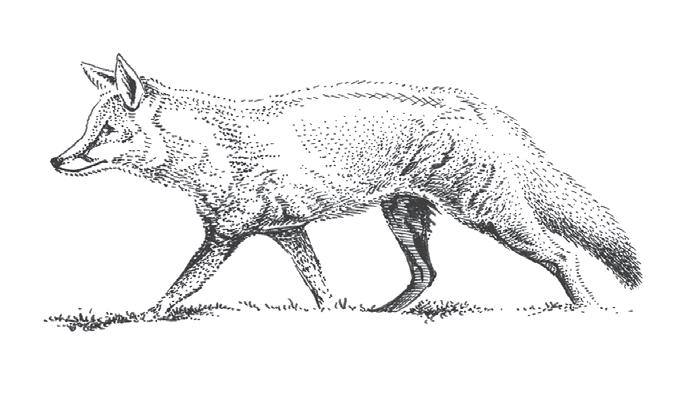
He was born under a corporate lawyer’s shed, a hundred yards from one of the main arteries pumping people and things into London. The clay of his birth-den throbbed. Next to the road was a railway which shook worms on to his head during the morning and evening rush hours.
The fox cub’s first bone was from this clay. It was about fifty million years old, and came from the wing of an Eocene protosparrow which had picked tropical horseflies from palm trees in Bethnal Green.
The cub’s second bone came from the wing of a feral pigeon that had been hit by a van delivering pork pies.
That second bone came when he was eight weeks old, for until then his parents, committed, sophisticated and cynical urbanites, had brought him mainly pizza (they preferred pepperoni), and curry (with a bias towards chicken tikka masala) from the bounteous dustbins of the East End.
The lawyer’s older children didn’t know and wouldn’t have cared that they had wild things in their garden: things more cat than dog, with rotatable ears and pupils that could change their shape depending on the intensity of the light; things that inhabited that grid of terraced streets far more intensely and intimately than the humans who’d mortgaged themselves to it and slaved to stay there. Those older children didn’t really live in the street at all. They fuelled up in an actual world so
3
that they could live in a virtual one. They have no part in this story.
But the lawyer had a young child. To her siblings she was a bore and an irritation.
Like many young children who can walk on two legs, she much preferred to walk on four, for then her nose was nearer the ground, and her palms soaked up sensation rather than hanging wastefully loose. Like the head of an agile flower she followed the sun. She acknowledged no boundary between herself and any non-humans, and no continuity with her siblings – for whom her contempt was complete.
She saw the fox cub the very first time he put his nose out of the ground, for she was lying on the trouble-free plastic grass watching earwigs. Eyes rarely meet without any preconceptions, but they did then, and when that happens the melding of worlds is potently alchemical. New stuff is created; stuff impossible according to the canons of chemistry or biology. The new stuff became part of the matrix of each and every cell in both bodies. If the matrix dissolved, the cells would collapse.
She did not give the fox cub a name. She had heard her parents call her by her name, and heard in it the claim of possession and control. This fox was self-possessed and self-controlled, and she knew that to control him would be to kill him. He was also, like the rest of the wild world, part of her, and since she did not accept that she could be named, she paid the fox the compliment of namelessness. All names, she knew, fall short.
And so I will not name her either.
The fox cub was her secret. She would no more have thought of telling her despairing childminder or her occasional parents
Cry of the Wild 4
about him than she would have thought of asking her brother for a look at his Instagram account.
She did not seek information about the fox cub – let alone information about foxes. The girl wanted only presence. All her five senses – and many, many more – were involved in the appreciation of presence, but they all worked together in a sort of multimodal palpation. This was palpation by as well as of the fox cub. Until we’re five, reciprocity rules. After that we learn to be alone.
The girl had not learned to be alone, and would have been disgusted to hear that it was expected of her. She was a wild thing in a wild place. No Metropolitan Borough Council told the beetles where to march or the sparrows where to fly, or decided when the magpies died. Though she lived in a house of deadly cleanliness, where every surface was swabbed with chemicals to keep wildness at bay, the air, even in the immaculately white living room, was full of spores erupting on cheese, plaster or skin, and viruses waiting to inject their RNA into house flies or au pairs; and the gut of the girl’s father, filled though it was with oysters and white burgundy from business lunches, was a bubbling vat of bacteria without which he’d be dead. The electric currents in the mother’s heart had gone wild the previous year, which had caused a bit of a panic in the Tuscan hills, and there was a sporting chance, according to the actuaries, that both the mother and the father would finally fall because the cells in her breast and his prostate would decide, wildly and disloyally, to go walkabout as their owners never had. And when the father and mother fell, they would go completely wild through a municipal chimney.
The girl, then, was wise to live as she, a wild thing, really was, in the place (wild, gentrified Bethnal Green) where she
Fox 5
really was. Such a kind of living is almost unknown for modern adults, and an adult who lives that way is quite likely to be locked up in a secure unit where they’ll meet a rather different kind of wildness, as well as the old sort.
The fox cub, despite the pressures of urban life, was never likely to stop being wild, which meant that he was never likely to stop being himself.
Being oneself involves having preferences. He did. He preferred the top left nipple, his sister with the extra claw, dawn to dusk, the smell of petrol to the smell of diesel, rats to squirrels for play – though not for eating – roses to chrysanthemums, Labradors to Jack Russells, almost anything to cats, chow mein to spring rolls, rump steak to fillet and lamb to pork, Costcutter to Tesco, mango to kiwi, women to men, oaks to sycamores, tangledness to tidiness, chicken legs to breasts, voles to shrews, human harmony to human conflict (he got a good view of the family arguments from a bed of azaleas), and worms to black beetles.
These preferences were strong. He was an opinionated, headstrong fox cub, about to become an opinionated headstrong fox. His mother almost despaired of him, and would have despaired of him if natural selection had let her.
He spent one exhilarating day in a central reservation, crouched inside a lorry tyre, his hair standing on end, deafened, shaken like a cocktail, and inhaling a cocktail of rubber, lead, cadmium, and many compounds from the bodies of Carboniferous sea animals from Arabia.
He ran so fast after a squirrel that his momentum carried him halfway up a yew tree where he was marooned for a day and saw, as few foxes ever get to see, just how human hair springs from the scalp, and how it sometimes gives up growing completely.
Cry of the Wild 6